
SPLIT-APPLE ROCK, AN ANCIENT, PURPOSE BUILT SOLAR OBSERVATORY
Unpublished

History (5)
SPLIT-APPLE ROCK, AN ANCIENT,
PURPOSE BUILT SOLAR OBSERVATORY.
By Martin Doutre
On the northern coastline of New Zealand’s South Island is a geological wonder that is world renown, traditionally called Split-Apple Rock due to its appearance as a giant sliced-in-two apple.
The giant boulder, given its height and fairly symmetrical round shape of about 18-feet in diameter, could weigh as much as 238 imperial tons (242 metric tonnes).
It appears to sit on a boulder pile composed of similarly high quality, hard granite components, whereas the general material of the surrounding area is of a softer or more-flaky composition, totally unlike the split-apple boulder or the platform boulders upon which it is cradled and housed.
The evidence suggests very strongly that this is not a natural geological stack, but a purpose built one to serve an important astronomical and calendar function.

A stock photo from the Internet shows just how immnse this granite boulder actually is. Remarkably, there appear to be little or no similar examples of large, dense granite boulders strewn about anywhere within view, as one would reasonably expect to find.
The general terrain of the area is predominantly a composite rock, made up of many varying elements. It is semi-hard and durable but quite crumbly under pressure and could never be used for making stone blocks. Whereas the incredibly hard granite found on the split-apple boulder was formed from molten magma under tremendous pressure far beneath the Earth’s crust, the immediate-vicinity, local terrain is seemingly devoid of any known deposits of similar material.
The giant split boulder sits on a boulder pile platform-island that does not appear to be a natural rock up-thrust, but more like a purpose built, piled-up structure of high quality, durable support boulders. The giant Split-Apple also seems to be locked into position by chock boulders to underpin, cradle and stabilise the two giant halves firmly into a set position and orientation.
The split boulder forms a gun sight-type “V” that points accurately at the vertical, lower edge of the sea-cliff 330-feet away (100 metres), at an angle approaching 59.5-60 degrees azimuth
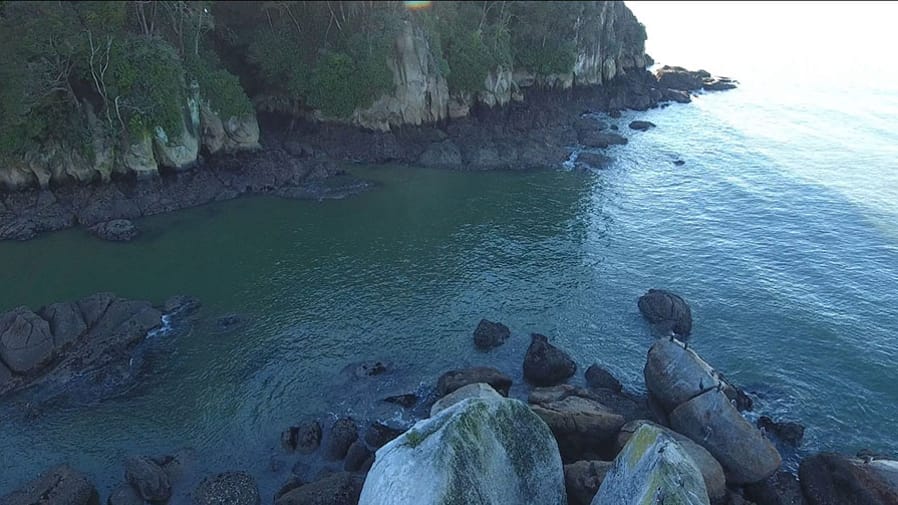
The split boulder forms a gun sight-type “V” that points accurately at the vertical, lower edge of the sea-cliff 330-feet away (100 metres), at an angle approaching 59.5-60 degrees azimuth.
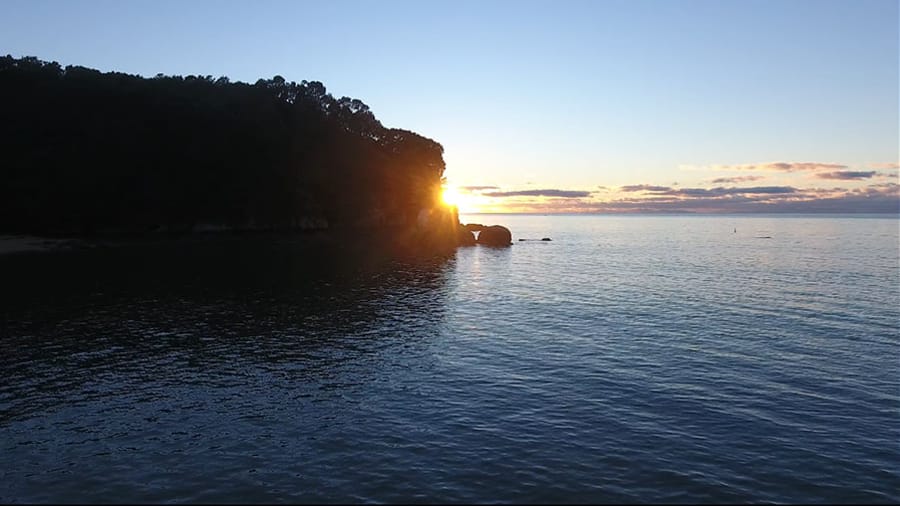
From the beach viewing position, one visually aligns the base of the split-apple “V” with the vertical edge of the cliff to form an accurate alignment onto the winter solstice, first-glint sunrise position. The sun, rising on a slight diagonal to the left (North), then climbs the edge of the cliff to launch itself into the sky from the cliff top. From the position of observation at beach level the sea horizon conjuncts perfectly with the base of the “V” and first-glint of the sun occurs low in the “V”.
The winter solstice sun climbing the cliff edge. The first-glint position seen at the base of the “V” represents the most northerly position the rising sun will move to in its annual journey up and down the eastern sea horizon and distant land-masses.
SPLIT-APS
SPLIT-APPLE ROCK ALSO WORKS PERFECTLY FOR DETERMINING THE EQUINOX SUNRISES
Whereas the sun rises at 59.5-60 degrees azimuth at the time of the Winter Solstice, at the Autumnal (March 21st) and Vernal (September 21st) equinoxes it rises at 90-degrees. To accurately witness the two annual equinox events through the Split-Apple "V" one moves to a more westerly position of the beach. By viewing through the "V" to ranges across the sea situated at 90-degrees azimuth, the exact day of the equinox can be accurately fixed.
At this point of the beach viewing position the "V" in Split-Apple Rock is half diminished in depth, but still highly visible and exploitable for cradling the equinoctial sun's orb. In the much magnified background is seen the distant range across the water, where the sun rises from a peak 1800-feet high (550 metres).
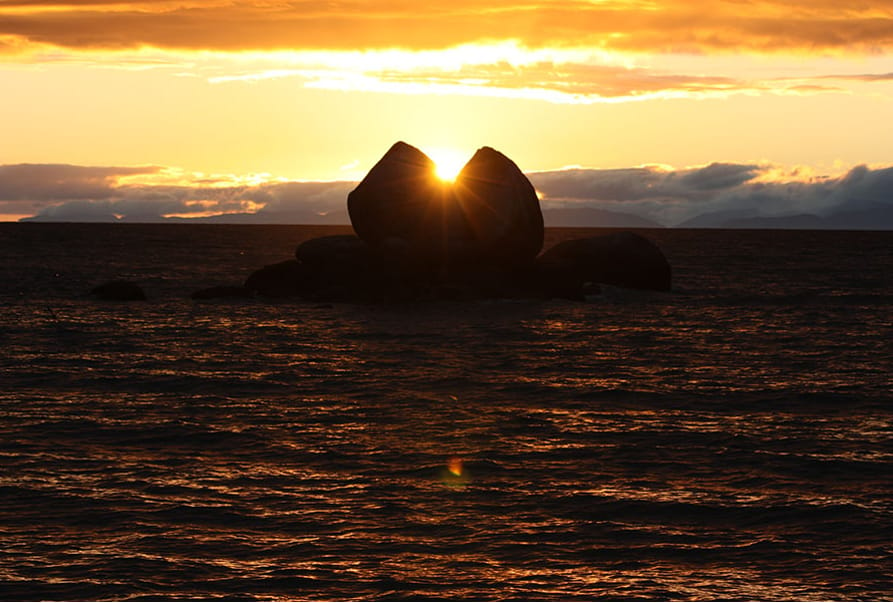
The equinoctial sun cradled in the base of the "V" after rising from behind the distant range. It then moves upwards into the morning sky on a slight diagonal to the north.
It is very apparent that Split-Apple Rock works perfectly as a solar observatory for both the winter Solstice and equinoxes. It would also work fine for the summer solstice sunrise (120-degrees) fix as well, although the "V" would be much diminished and represented only by a small trough in the crown of the boulder, as seen from the observer's position on the beach.
THE SUPERMOON RISE AT THE EQUINOX
On the occasion of the 2019 autumn equinox for the Southern Hemisphere a super moon rose almost exactly on the equinox line. This was a rare event not to be missed.
On the evening of the equinox the super moon rose through the "V" of the Split-Apple very close to the solar equinox rise position and is seen here cradled in the "V".
This extreme northern position along the shoreline is where one would need to be in order to observe the summer solstice for the Southern Hemisphere, using Split-Apple Rock as the outer marker. The "V" aspect of the boulder is much-diminished to only a concave trough, but would be sufficient for a finite fix on the sunrise. Alternatively, the right-hand base of the boulder could be used to capture "first-glint" of the sun on the horizon, followed by its diagonal climb up the edge of the boulder to the trough position.
On this line of sight, just above the beach, is a wide assembly flat-area where ancient people could once have gathered for their summer solstice festivities. That expansive piece of terrain has not been subjected to modern-day machine modifications, as there would be no access due to steep hills behind.
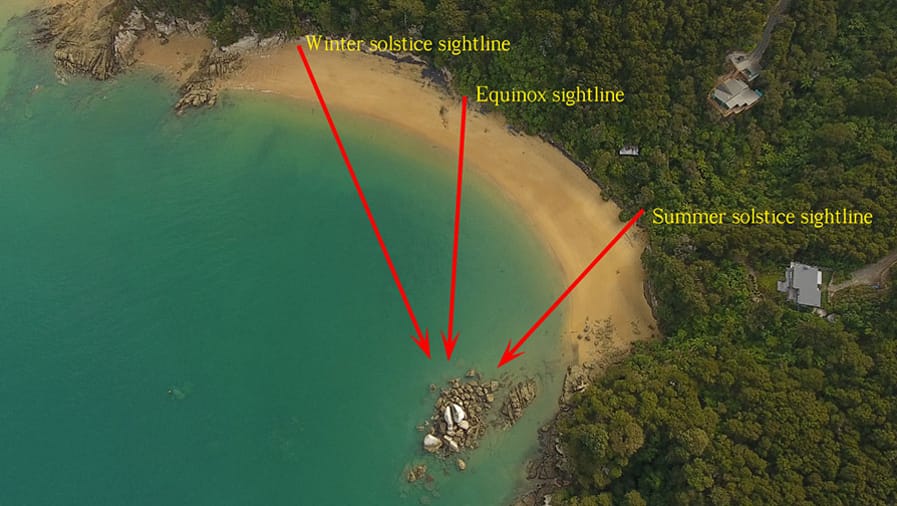
These are the 3 positions along the beach where ancient astronomer-priests would stand to witness the significant, annual solar days using the Split-Apple outer-marker, and, thus, have the ability to keep their 365.25-day calendars completely correct.
Source: www.celticnz.co.nz (and this is just part of the article!)

Hi, I Am Jane Doe
CEO Of Best Blog Ever
Lorem ipsum dolor sit amet, consectetur adipisicing elit. Autem dolore, alias,numquam enim ab voluptate id quam harum ducimus cupiditate similique quisquam et deserunt,recusandae.

Get Our Best Selling Product!
You just read about this...
Super excited about this product? We are, too! We just wrote this whole blog post that mentions it.
Ready to buy it? Get access to the Product here:

PAGES
SOCIAL
